




Water Conservation: A Necessity for Pakistan's Future
Introduction
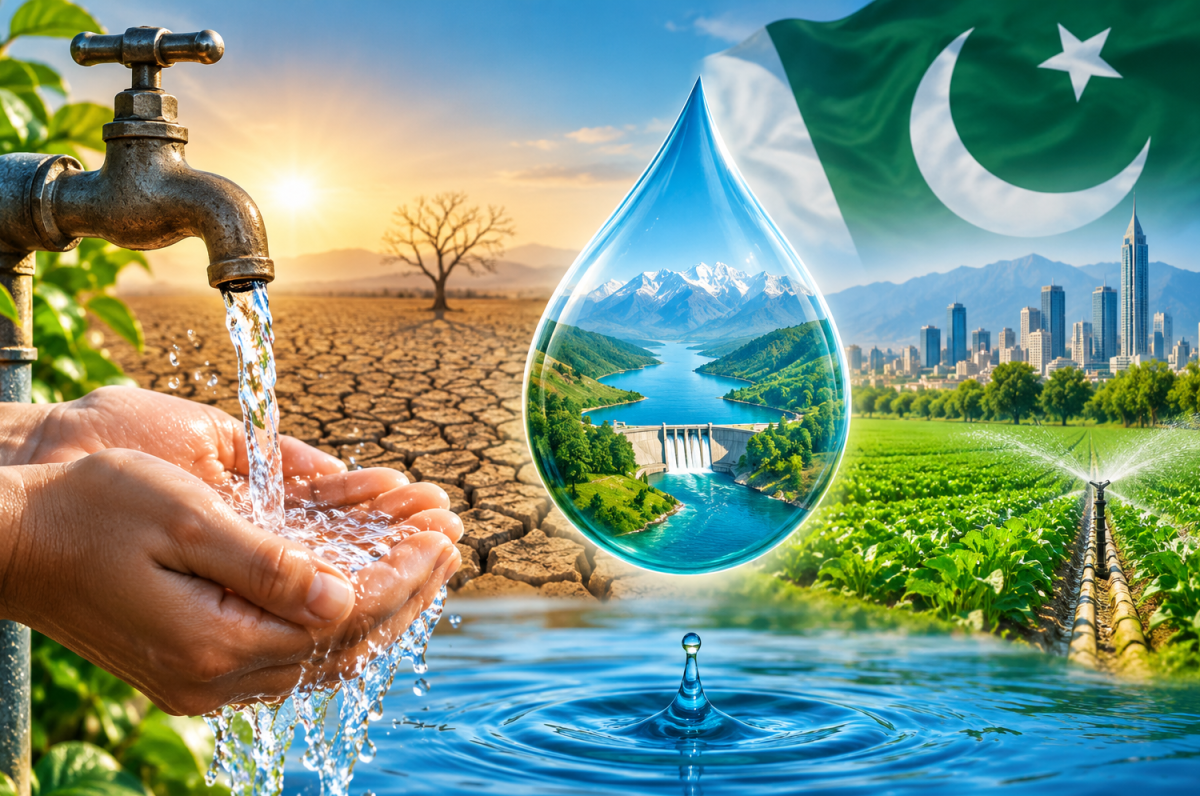
Water is one of the most valuable natural resources on Earth. Human life, agriculture, industry, energy production, and the environment all depend on a reliable supply of freshwater. For Pakistan, water is particularly important because the country’s economy and food security are closely connected to the Indus River system and irrigated agriculture. However, Pakistan is facing increasing pressure on its water resources due to population growth, inefficient use, groundwater depletion, pollution, climate change, and inadequate management. Pakistan’s National Water Conservation Strategy notes that per-capita water availability fell below the commonly used scarcity threshold of 1,000 cubic metres in 2010.
The water challenge in Pakistan is therefore not simply a question of whether the country has water. It is also a question of how water is managed, distributed, conserved, and used. The World Bank has emphasized that Pakistan’s water security challenges involve governance, irrigation, urban water supply, pollution, and increasing demand. If Pakistan wants to ensure food security, economic development, public health, and a better quality of life for future generations, water conservation must become a national priority.
Water and Pakistan’s Economy
Pakistan’s economy is strongly dependent on agriculture, and agriculture depends heavily on water. The Indus Basin Irrigation System is one of the largest irrigation systems in the world and supports millions of hectares of agricultural land. According to Pakistan’s National Water Conservation Strategy, the Indus Basin provides more than 175 billion cubic metres of water annually and supports approximately 17 million hectares of irrigated cropland.
Crops such as wheat, rice, cotton, sugarcane, and maize require substantial quantities of water. Agriculture also provides employment and income to a large part of the population and plays an important role in Pakistan’s food supply and exports. Consequently, a shortage or inefficient use of water can have consequences far beyond agriculture. It can affect food prices, employment, rural incomes, industrial activity, and overall economic stability.
The relationship between water and agriculture also creates an important opportunity. Better water management can allow farmers to produce more with less water. The World Bank has supported projects in Punjab that promote climate-smart technologies and improved water-use efficiency among small farmers. Thus, water conservation should not be viewed simply as restricting water use; it should be viewed as using water more productively.
The Growing Water Challenge
Pakistan has historically benefited from the rivers, glaciers, rainfall, and groundwater associated with the Indus Basin. However, population growth has substantially increased demand for water. As the population grows, more water is needed for drinking, sanitation, agriculture, industry, and energy.
At the same time, Pakistan's water resources are under pressure from inefficient management and changing climatic conditions. The World Bank has identified increasing population, rising demand, climate change, and pollution as interconnected challenges for Pakistan’s water security.
Climate change makes the situation even more complicated. Pakistan experiences both severe floods and periods of drought. The devastating floods of 2022 demonstrated the destructive power of excessive water, while dry periods demonstrate the consequences of insufficient water. These two situations may appear contradictory, but they are actually part of the same water-management challenge. Pakistan needs systems capable of storing, managing, distributing, and conserving water during both extremes.
Climate change can also affect agriculture by altering rainfall patterns and increasing temperatures. Higher temperatures can increase water requirements for crops and livestock, while changes in rainfall can make agricultural planning more difficult. The World Bank has warned that climate-related risks and environmental degradation pose major challenges to Pakistan’s economic development and agricultural productivity
Inefficient Use of Water in Agriculture
One of Pakistan’s greatest opportunities for water conservation lies in agriculture. Traditional irrigation methods can result in significant losses, particularly when water is applied without considering crop requirements, soil conditions, or weather conditions.
Flood irrigation, for example, distributes large quantities of water across fields. Although it can be effective under certain conditions, it may result in inefficient water use when fields are poorly levelled or irrigation is not properly managed. Modern methods such as drip irrigation, sprinkler irrigation, laser land levelling, and improved irrigation scheduling can help farmers use water more efficiently.
Water conservation should also involve choosing crops according to local climatic and water conditions. Some crops require considerably more water than others. Farmers need access to research, extension services, technology, markets, and financial support so that they can adopt practices that conserve water without sacrificing their livelihoods.
Pakistan has already recognized the importance of this approach. For example, the World Bank’s Punjab agricultural project has focused on climate-smart technologies and improved water-use efficiency for small farms. Such initiatives demonstrate that conservation and agricultural productivity can complement each other.
Groundwater: A Hidden Concern
Surface water is not Pakistan’s only source of freshwater. Groundwater is also extremely important for households, agriculture, and other activities. In many areas, tube wells provide water when canal or river supplies are insufficient.
However, excessive groundwater extraction can create serious long-term problems. When groundwater is withdrawn faster than natural processes can replenish it, underground reserves decline. In some areas, groundwater quality can also deteriorate because of salinity and contamination.
Pakistan’s National Water Conservation Strategy specifically identifies groundwater overdraft, salinity, waterlogging, and ecosystem deterioration among the country’s significant water-related concerns.
Groundwater conservation therefore requires better monitoring and regulation. Farmers and communities need information about groundwater levels and quality, while authorities need effective systems for managing extraction. Rainwater harvesting and artificial groundwater recharge can also help replenish underground water resources in suitable areas.
Water Pollution: Wasting the Water We Have
Water scarcity is not only caused by using too much water. Pollution can also make available water unusable or unsafe.
Domestic sewage, industrial waste, agricultural chemicals, plastics, and other pollutants can enter rivers, canals, lakes, and groundwater. When water sources become polluted, communities face higher costs for treatment and may suffer serious health consequences.
Safe drinking water is particularly important for children and vulnerable populations. Poor water, sanitation, and hygiene conditions can contribute to disease and undermine human development. The World Bank has identified improvements in water, sanitation, and hygiene as important for Pakistan’s human capital and health outcomes.
Therefore, water conservation must include water-quality conservation. Saving polluted water does not solve the problem. Pakistan must prevent pollution at its source, improve wastewater treatment, enforce environmental standards, and encourage industries and communities to dispose of waste responsibly.
Water Conservation in Pakistani Cities
Pakistan’s rapidly growing cities face their own water challenges. Urban populations require water for drinking, households, businesses, industries, sanitation, and public services. At the same time, leaking pipelines, poor infrastructure, groundwater over-extraction, and inadequate wastewater treatment can reduce the efficiency of urban water systems.
Urban households can contribute to conservation through simple measures. Leaking taps and pipes should be repaired quickly. Water should not be left running unnecessarily while washing vehicles, cleaning homes, or brushing teeth. Rainwater can potentially be collected for gardening, cleaning, and other non-drinking purposes where appropriate systems are available.
Buildings can also be designed to use water more efficiently. Low-flow fixtures, rainwater harvesting systems, wastewater recycling, and water-efficient landscaping can reduce demand. New housing schemes and commercial developments should incorporate water conservation into their planning rather than treating it as an afterthought.
The Role of Rainwater Harvesting
Pakistan receives substantial rainfall during certain periods of the year, but rainfall is not evenly distributed across the country or throughout the year. Heavy rainfall can sometimes cause flooding, while water shortages occur during dry periods.
Rainwater harvesting provides one possible way of addressing this imbalance. Water collected from rooftops and other suitable surfaces can be stored and used for activities such as gardening, cleaning, and groundwater recharge, subject to appropriate treatment and safety requirements.
At the community level, small reservoirs, recharge structures, ponds, and other forms of local water storage can also help capture rainfall. Such measures cannot replace large-scale water infrastructure, but they can complement it and improve local resilience.
The experience of Pakistan’s floods also demonstrates why water storage and management are important. The World Bank has described freshwater storage as an important part of climate adaptation because it can help retain water for drier periods while also contributing to flood management.
The Importance of Public Awareness
Government policies alone cannot solve Pakistan’s water problem. Citizens must also understand the value of water.
Water conservation should become part of everyday life. Schools and universities can educate students about responsible water use. Television, newspapers, social media, and community organizations can promote practical conservation measures. Religious and community leaders can also encourage responsible use of natural resources.
Children can play an especially important role. When students learn to close taps, report leaks, avoid unnecessary water use, and understand the importance of clean water, these habits can influence their families and communities.
Public awareness is most effective when people are given practical alternatives. Telling people simply to “save water” is less useful than showing them how to do it. Awareness campaigns should therefore explain specific actions that households, farmers, businesses, and institutions can take.
Government and Institutional Responsibility
Individual action is important, but Pakistan’s water crisis cannot be solved by households alone. Strong institutions and effective policies are essential.
The government needs better systems for measuring water availability, groundwater extraction, agricultural consumption, urban demand, and pollution. Reliable data can help policymakers make better decisions.
Water infrastructure also requires investment. Canals, pipelines, drainage systems, treatment plants, reservoirs, and urban water networks must be properly maintained. Poorly maintained infrastructure can result in water losses and unreliable services.
At the same time, water governance must be transparent and coordinated. Pakistan’s water system involves federal, provincial, and local institutions, as well as farmers, industries, and communities.
The National Water Conservation Strategy for 2023–27 also demonstrates that water conservation has been recognized at the national policy level. The challenge is to translate strategies and policies into consistent implementation.
What Can Pakistan Do?
Pakistan needs a comprehensive approach rather than a single solution. Several measures can contribute to a more water-secure future:
o Modernize irrigation systems and promote efficient technologies such as drip and sprinkler irrigation where appropriate.
o Improve agricultural water productivity so farmers can produce greater value from each unit of water.
o Promote rainwater harvesting in homes, schools, offices, farms, and public buildings where feasible.
o Regulate groundwater extraction and improve monitoring of underground water reserves.
o Reduce leakage from urban water-supply networks.
o Improve wastewater treatment before sewage and industrial waste enter natural water bodies.
o Promote water-efficient appliances and practices in households and businesses.
o Protect wetlands, rivers, forests, and watersheds, which play important roles in maintaining ecological water systems.
o Strengthen water-related institutions and improve coordination among different levels of government.
o Invest in research and technology for climate-resilient agriculture and water management.
o Educate the public, particularly young people, about responsible water use.
o Develop better systems for flood and drought management, including appropriate water storage and early-warning systems.
These measures should not be considered separate initiatives. They are interconnected parts of a national water-security strategy.
Conclusion
Water conservation is no longer simply an environmental issue for Pakistan. It is an issue of food security, public health, economic development, energy, livelihoods, and national resilience. Pakistan’s growing population and changing climate are increasing pressure on water resources, while inefficient use, pollution, groundwater depletion, and inadequate infrastructure make the situation more difficult.
The country does not necessarily need to solve its water problems simply by finding more water. It must learn to manage existing water resources more intelligently and sustainably. As the World Bank has noted, Pakistan’s water challenge involves not only physical scarcity but also the efficiency and fairness of water management and allocation.
The responsibility belongs to everyone. Farmers can adopt efficient irrigation practices, households can reduce unnecessary consumption, industries can treat wastewater, institutions can improve management, and governments can invest in infrastructure and enforce effective regulations.
The choices Pakistan makes today will influence the availability and quality of water for future generations. Water conservation should therefore be treated not as a temporary response to drought or shortage, but as a long-term national commitment. Every drop saved today can contribute to a healthier environment, stronger economy, and more secure future for Pakistan.

Ovais Ali Khokhar, as Founder and CEO of House of Elaan & Ovaisco Group, has revolutionized the real estate industry with innovative strategies that blend marketing, investment, legal services, and creativity. His efforts in international relations have led to significant global partnerships. He is deeply invested in youth empowerment, aiming to nurture the next generation of leaders and drive forward a resilient and vibrant future. His work is characterized by a strong commitment to collaboration, innovation, and a vision for a globally connected, sustainable future.